Pages

Showing posts with label book. Show all posts

Monday, December 18, 2017

Meet Michael Sheahan, Author and NYPD Detective

Michael Sheahan is a highly decorated retired NYPD Detective from the NYPD/FBI Joint Federal Task Force. Michael is also an award winning Childrens book author, Singer-Songwriter, producer and Publisher. Many years ago he formed a conglomerate of companies under Finest Worldwide Entertainment (Finest Music, Finest Books, Finest Media, Fine St Records & Finest Worldwide Management Group). Michael created a character named Mr. Holidays, and released his first book with a musical CD & Dance instructional DVD titled “Mr. Holidays Presents The Roof Top Hop” It won three of the biggest awards in the children’s book industry for Best Holiday Book, Best Holiday book with music/Theatrical, and the prestigious Independent Books Publishers award.

Michael hopes he can donate over 100,000 books and ship them in time for Christmas 2017. He titled this campaign "The Gift Keeps Giving" cause he feels it was a gift from above that inspired him to create Mr. Holidays. A gift of being honored with three awards for his creation, and a gift to be able to pay it forward to bring a smile to children's faces this Christmas 2017 Holiday Season.

1. How did you come up with the character of Mr. Holidays, and what would you most like our readers to know about him?

I created Mr. Holidays to be a safe keeper of all the holidays in the calendar year. To promote the old traditions as well as create new fun ways to celebrate with family and friends.

2. What would you like people to know about you and your books?

I think your readers should know that deep down inside I’m still a big kid, and I have always loved and cherished sharing the holidays with family and friends. It was always a time in my house growing up where we just slowed down enough to continue the family traditions to spend, share and enjoy quality time with each other making new memories each and every year. Christmas wasn’t a day when I was a child. It was at least two weeks or more spread out visiting friends and family. It kind of kicked off a week after Thanksgiving. I think it’s such an important time especially for the children to be in the middle of the adults conversation with their grandparents, parents, aunts and uncles, siblings, cousins and friends sharing and learning the family traditions. Just hearing the stories and old tales that were passed down from generation to generation. I feel it’s so important to their upbringing knowing that they have the support and a solid foundation helping them feel secure and loved.

3. Would you tell us a little more about how you were inspired to create Mr. Holidays?

I was inspired to create Mr. Holidays through several experiences with my own children and their friends. On one occasion we had a birthday party for our youngest child who at the time just turned six or seven. We had several friends over and had a really enjoyable day playing games and having pizza and all sorts of goodies for desert. By the end of the evening the children were settling down waiting to be picked up by their parents. I pulled out my guitar and we had a sing-along. After several songs that were known by the children I started singing a few Christmas songs because it was only a few weeks away. While every one was singing one child pipes up to all of our surprise that he does not believe in Santa. I looked at my sons face expressing a shocked questionable look, and I quickly replied well that’s fine that you don’t believe in Santa, but in this house we love Santa.

When all the children left and my little guy went to bed I asked my wife how could that little child already not believe in Santa…He’s so young? My wife replied "for some people Christmas is just another day. With both parents working full time it’s not easy..."

Thanks, Michael!

Tuesday, June 20, 2017

Meet Chris Davis, Author

Chris Davis is the author of a new young adult novel, The Adventures Of Merrick The Viking. You can learn more about the book by visiting www.theadventuresofmerricktheviking.com. The novel is available on Amazon in both paperback and Kindle formats. See also this link to find the book in other ebook formats.

1. What gave you the idea to write The Adventures Of Merrick The Viking?

I really started looking at time periods that intrigued me, and I am a bit of a day dreamer, so I would wonder what it must have been like to grow up as a young teen in about 700 to 900 AD when all of Europe is still new and pre-America. So one thing led to another, and my protagonist turned out to be a young boy who happened to come from a long line of extremely well-crafted boat builders in a small Viking village. From there the adventure starts.

2. Have you always been interested in the history of Vikings and Scandinavia?

I have been an admirer of history and how cultures evolved over time, and I am particularly interested in the Viking and Irish culture, but mostly the advancements in trade and influences on culture not necessarily on the violent history. I also tried not to mention any exact locations or historical names, just more of a reference. Also, I added in some hidden fun references to the Viking famous folklore.

3. Would you tell us a little more about the character of Merrick and what he experiences during the course of the book?

The main character is Merrick, and I am writing this as a series of books with Merrick as the main character. He starts off around 16 to 17 years old, forced out of his village, and he really finds himself growing up pretty fast. Luckily for him, he has special traits that make him unique. He finds himself in survival mode but still keeps his adventurous personality as a coming of age teen. Plus, yes, once he makes it into an Ireland, he happens to start a new romance with a real headstrong Irish redhead girl, Kira, that keeps him in check.

4. What do you see as the challenges of writing for a young adult audience, and what do you most enjoy about writing for this audience?

I see the challenges of a writer these days is a difference with how young readers want immediate action and also wants to follow and enjoy characters into series of books, letting their imagination turn page by page. My biggest obstacle was from the beginning: it is hard to market a book with Vikings that is not gruesomely violent, but I do have to acknowledge, yes, in history they did have groups of Vikings that plundered and destroyed villages, so I am carefully keeping the story more on a positive adventure.

5. Are you working on any new writing projects at the moment?

Yes, I am currently writing the second book in the series which I refer to as Merrick Book 2 and should be a similar style and design so this should make for happy readers to continue the journey. To me I am just fascinated of the time to pull your boat up into an unknown port and be able to communicate and trade your goods--plus exchange ideas, technology, techniques, and food items. Even how that time period was able to put a universal price on their goods and services.

Thanks, Chris!

Tuesday, February 28, 2017

Meet Steven Burton, Author

Steven Burton describes himself as a part-time author, chef, old soldier, little league football Coach, and best buddy of Jack Kitty. He writes about everyday people and real-life experiences. Later this year, he'll be releasing a book called Midlife Man in Crisis. You can read excerpts from that book and many other selections of his work on http://beneaththerainbow.com. And find him on Facebook at https://www.facebook.com/beneaththerainbow/.

1. What inspires you to sit down and write about something?

My inspirations come from the world around me. I was in the U.S. Army for 20 years, and along the way I have lived all over the world, experienced many different cultures, and talked to people from all walks of life. Watching how other people interact with each other and listening to their stories has become a kind of hobby of mine.

Pop culture bombards us with tales of the rich and famous, but I think most people have great stories to tell regardless of their social or economic standing which is why I started the Beneath The Rainbow short story site. When you drill down in to the events of most people's lives, you will find heroes, villains, and protagonists worthy of a Shakespearean drama.

2. Would you tell us a little bit more about your forthcoming book?

Midlife Man in Crisis chronicles some of the defining events men (and some women) go through when they hit that period of life the dictionary defines as middle age. I try to approach the subject with a touch of humor although there are moments when some of the events can be described as drama, or so my beta readers tell me.

Tackling issues involved with the loss of youth, no longer being a parent of young children, and even the oft maligned "midlife crisis girl" event wasn't as easy as I thought it would be, although it has been fun. The events described in the book have either happened to me or someone I was close to, with maybe a slight bit of exaggeration in the telling. After all I am in old soldier, and we are supposed to add a little hyperbole to our stories.

3. Why do you think that our culture talks so much about the idea of the midlife crisis, and what does "midlife crisis" mean to you?

There are roughly 82 million people in the United States between the ages of 45 and 65 (27% of the population), so put into perspective that is more people in that demographic in the United states then there are people living in Germany, France, or any western European country. You could multiply the population of Canada two times and still not have as many people as the United States has in middle age category. A big reason we talk about it so much is there is a lot of us.

In my own experience, midlife crisis is what happened when I slowed down enough to realize how much the world had changed around me. Empty nest had hit, the kids had all moved out, my wife was now an ex wife, and even worse when cute college girls talked to me, they used the tone and demeanor reserved for friends of their parents and grandparents, not the flirty banter that always been our form of communication before. When you're a middle-aged man at a restaurant, and the 20-something girl who is your waitress says, "Thank you, sir".......she really means SIR.

4. You post original work on your website on quite a regular basis. What are some of the best responses you've received from readers?

I have received some great comments and words of encouragement since I put up Beneath The Rainbow, but my absolute favorite was when a guy I hadn't seen since boot camp posted, "I always wondered what happened to my buddy" under a short story I'd written about joining the Army. Prior to his comment, I hadn't seen or heard from him since 1981. We didn't have cell phones, computers, etc back then, and snail mail could take two to three weeks to travel one way overseas, so you couldn't really keep in touch with all the friends you made through out your military career. To hear from someone I hadn't talked to in 20+ years, that was a real treat.

5. What else would you like readers to know about you and your writing?

I have a kind of a sardonic sense of humor, and there are times people don't understand when I am laughing at myself, and I do laugh at myself a lot. My hope is that anyone reading my writing gets that aspect of my work.

Prior to this book, my writing has been confined to blog posts and ghost writing for others who have tailored my work to fit their own style. I am anxious, and I admit a bit scared to put out an entire book with my own name on it.

Thanks for spending time with me, Mandy.

Thanks, Steven!

Wednesday, June 8, 2016

Meet Rachel McMinn, Author

Rachel McMinn is high school English teacher who was born in the UK and who lives in Connecticut. She is also the mother of a two-year-old girl. Her debut novel, The Other Side of Loneliness, was published in June of 2016. Learn more about the book on Amazon and Goodreads.

1. How did you come up with the idea for the story told in your debut novel?

As a teacher, I have met many students who have faced a lot of hardship in their short lives. What always amazes me is the utter resilience they display. They manage to navigate their way through problems that, as an adult, I am not sure what I would do about. My novel was inspired in part by that resilience and the idea that so many of us are going through our day with problems that we hide from the rest of the world. I am a firm believer in being kind to everyone since sometimes the person with the biggest smile is the person facing the greatest hardship behind closed doors. At some point we have to let others in because a hardship shared, is less of a hardship.

2. How would you describe your protagonist, Riley?

Riley is a teenage girl that has experienced a tragedy that has turned life as she knows it, upside down. She has a lot of emotions and feelings that she isn't sure what to do with, feels like she knows it all, and at the same time feels like she knows nothing at all. The teenage years are tough anyway; school, friends, relationships, trying to figure out who you are and what you believe and what you want to do with your life. There is a lot of pressure. Add a traumatic experience to that and you have a recipe for disaster. Riley is very typical in that way. She is balancing her emotions and trying to understand how you can love and hate at the same time. There is a very confusing duplicity to life and emotions, and Riley is learning that lesson early in life. She is scared to let friends and loved ones help because she has experienced loss and doesn't want to risk losing anyone else. I think that is a feeling that teens and adults alike can relate to.

3. As an English teacher, when do you find the time to work on your own writing?

I'm a full-time English teacher with a two-year-old daughter so life is certainly hectic. I keep a notebook in my purse and write when I have a spare moment: waiting rooms, when my daughter naps, lunch breaks. I still nurse my daughter, so I have to pump at work and I have gotten pretty good at balancing the pump and my notebook! At home I will get on my laptop for twenty minutes before I start getting ready in the morning or for a half hour before I go to bed. I might not have a huge block of time to write but all of those little sessions add up. I wrote The Other Side of Loneliness in about 7 months.

4. What audience did you have in mind as you wrote your novel--were you thinking of your students in this context as you wrote?

I was absolutely thinking of my students as I wrote this novel. As a teacher you don't just teach your subject area; you also give a lot of pep talks about handling life. I don't pretend to know it all, but I try to give my students good advice so they can make better decisions or try to get them to stand back and analyze a situation before acting. I think about what I wish I had known when I was their age. This book takes some of those life lessons and puts them into novel form. I think that young adults and adults will enjoy this book because the real core message is that we all have issues that we hide from the public; we all struggle and that is okay. It is okay to not know what to do. We can choose to stay stuck and suffer or we can accept our issues and figure out what to do from there. This book is about the importance of friends and support systems, forgiveness, and that understanding that no one is perfect. That is what makes us human.

5. As the school year comes to an end, what are your plans for the summer?

Well, contrary to popular belief, teachers do not really get the summer off! I will be teaching summer school a few days a week and spending some time planning for next school year. When I am not working, I will be spending a lot of time at the beach; I love being outdoors! I run and summer is really my training season, so I will be doing that in preparation for a half marathon in the fall. I have a two-year-old daughter, Lillian, and I love every single moment with her. I will be spending a fair amount of time finger painting, collecting bugs, and visiting the farmer's market with her. Of course, I hope to have some time to read and write and I'll be waiting to be inspired for my next novel!

Thanks, Rachel!

Thursday, March 24, 2016

An Excerpt from The Wave by Lochlan Bloom

This striking black and white cover for The Wave by debut novelist Lochlan Bloom caught my attention--doesn't it make you want to find out more about the story?

The plot suggests an interesting mix of meta-fiction with a slightly dark edge and hints of David Lynch. After speaking to the author online, Lochlan sent me an excerpt from the opening of the book which appears below.

The Wave will be released next month by Dead Ink Books and is available to pre-order from: deadinkbooks.com/product/the-wave-by-lochlan-bloom/

Lochlan has completed recent projects for BBC Radio Scotland and written for Slant Magazine and Ironbox Films amongst others. He is the author of several pieces of short fiction including the novella Trade and The Open Cage.

The BBC Writersroom describes his writing as "unsettling and compelling… vivid, taut and grimly effective work," and he has written for Litro Magazine, Porcelain Film, EIU, H+ Magazine as well as Calliope, the official publication of the Writers’ Special Interest Group (SIG) of American Mensa.

He has attend the invitation only SCENEinsiders event at the Gothenberg Film Festival and currently has a feature length script in production with Porcelain Film. He has also taken part in workshops from the Publishing Training Centre and EdinburghMediabase.

Lochlan lives in London and does not have a cat or a dog.

For more details visit: http://lochlanbloom.com.

*

(from) The Wave

μ opened the front door and there it was. It struck him as unusual. There was never normally post for him – some bills perhaps – but even that was less now that he had moved flats.

He turned the envelope over, feeling its weight. The heavy-duty manila suggested its contents might be valuable. His name was written on the front in thick marker pen. Brightly coloured stamps and postmarks crowded together – wavy lines of red ink. One mark looked like it read: "Brasil" and another: "Airmail." μ didn’t know anyone in Brazil.

He pulled at the thick glue that held the envelope shut. Inside lay a sheaf of typed sheets. Names and descriptions of locations were interspersed with clips of dialogue, as if someone had been following people, noting down their actions. It made no sense. Had some confidential dossier been sent to him by mistake? He looked closer.

It appeared to be some sort of film script. He didn't read these sorts of things and he struggled to grasp the layout. Most of each page was white space, broken only by small regular clumps of text floating in the centre. Why had it been sent to him?

He leafed quickly through. Page after page was covered in light grey font reminiscent of old-fashioned manual typewriters. He ran his finger over one of the pages but it was smooth and appeared to have been printed rather than hand typed. Who would send him this? He checked the envelope again; it definitely looked like one of the stamps read "Brasil." There was no letter of explanation enclosed.

μ threw his bag on the couch and placed the script on the table, orbiting around it. The flat took up two floors of a draughty old building that had been half-heartedly renovated in order to rent out. The landlord was never there and his flatmates weren’t back by so he had the place to himself.

He flicked through the first few pages. What a disappointment! Twelve pages in and it was clear that this was no "Citizen Kane." Instead there was a confused story about a character named Ddunsel, who seemed to be the main suspect in a case involving several abductions, child molestation and murder. In several places graphic descriptions of his crimes were included. He seemed to be some sort of all-powerful psychopath. The action jumped around at random and the dialogue was uniformly poor. Who had sent him this drivel?

The few sections that contained anything approaching a decent plot were ill-thought-out and μ felt a dislike for the writing. There was no narrative line, only a haphazard collection of scenes, and it was obviously written by someone with little love of language.

Despite the clumsy phrasing, μ felt it was all written for a purpose, as if by some malevolent intelligence. He was in the middle of reading one repulsive section, describing the brutal rape and murder of a young boy by Ddunsel, when the sound of the front door made him jump.

They would all be returning for dinner. μ put the manuscript down and then, on impulse, covered it with a magazine. He had nothing to hide, but still, child murder was not what he wanted them to think he usually read.

He was sharing the house with foreigners. They entered, talking amongst themselves, and threw a nod in μ's direction. He nodded back and they busied themselves preparing their evening meal. There were only three others that actually lived there – Georgi, Ivan and Katarina – but often their friends would come around in the evenings and as many as ten or twelve of them would sit in the shared space eating and talking.

μ had not stayed in the flat for long but it already felt a lot better than the place he had been before. It was hard to believe that he had stayed in that old house for so long. Now he was sure his problems were behind him.

"All those people living on top of each other, rubbing against each other every day," he thought. "It's just as well that I moved out."

*

Learn more about The Wave by visiting Dead Ink Books.

Thursday, March 10, 2016

Meet Randall Barnes, Author

Randall Barnes is a college freshman and the author of the young adult novel series, The Diary of Aaliyah Anderson. He recently released The Diary of Aaliyah Anderson: Volume II. You can find him on Twitter, Instagram, and Periscope as @AuthorRandallB, and be sure to check out his YouTube channel.

1. How did you come up with the character of Aaliyah?

I came up with the character of Aaliyah Anderson seeing the wonderful, ambitious young women around me at my high school. I didn't see a clear representation of them in the media. I knew their stories were intriguing, entertaining, and worth chronicling in a novel series, so I documented all the characteristics of these ladies and created Aaliyah Anderson. I also consider Aaliyah the female version of me. We share the same ideologies and dreams. We both also share one main weakness, overthinking things!

2. What inspired you to start writing novels for young adults?

There's a void in the industry to reflect what's truly going on in the lives of young adults. I got tired of seeing every other book for young and reluctant readers be about linear topics such as relationships. We're more diverse than that and The Diary of Aaliyah Anderson novel series shows that. Within the books, we tackle subjects that have never been discussed before in a commercial novels series such as the corruption that plagues many public school systems and the effect your environment has on your mental development. I wanted to prove that you could craft higher minded works of fiction for young people that are still entertaining.

3. What are some of the experiences we'll see Aaliyah face in your latest book?

The first edition in the series was the introduction to Aaliyah. Now, we get into the drama! Aaliyah is tangled up in a heated student presidential election with her enemy Latasha, who is eerily reminiscent of Donald Trump in this election. Latasha hurls non-stop insults at Aaliyah and doesn't specify what she'd do to make Clarkson a better school. Aaliyah is actually bringing up good ideas and is presenting herself as a phenomenal representation of the student body, but they're supporting Latasha because of the entertainment factor. It's amazing that I predicted the 2016 Presidential Race back in 2012!

Aaliyah also has to deal with the increasing violence that's occurring in her hometown of Willowsfield, Georgia. Willowsfield is statistically the #1 most dangerous city in America, and the novel shows that. For example, her best friend Allison is kidnapped by her significantly older ex-boyfriend, and Aaliyah has to find her before she gets hurt. The street gangs of Willowsfield are engaged in a social media war with the gangs of Worthington, Georgia, and the beef culminates at the Howard-Jones vs. Worthington High Football game. Aaliyah has to find her way to success while keeping her sanity and life intact.

4. How has Wattpad helped you as an author?

Wattpad showed me who my audience is. I used to limit myself by saying that my reader base is young women between the ages of 13-18. Looking at my numbers on Wattpad, I found that college age readers also enjoy The Diary of Aaliyah Anderson. It's also allowed me to build a platform for my novels that propelled me to get a book deal back in 2014.

5. As a college student, when do you find time to write your novels?

It's easy to find time to write in college. When in college, you have the freedom to set your own personal schedule. I currently have four classes on Mondays and Wednesdays but only one in the afternoon on Tuesdays and Thursdays. That means Tuesdays and Thursdays are my writing days! I try my best to write at least 500 words or complete a chapter of the latest book I'm working on. I was told by one of my author mentors back when I was in 10th grade that writing books in college would be challenging. I'll go as far as to say writing novels in high school was more challenging because of the lack of freedom. Besides, it's all about your passion for what you're doing. No matter what schedule constrictions you have, you always have time to write.

Thanks, Randall!

Wednesday, November 11, 2015

Meet Deanna Martinez-Bey, Author

The author of the new novel When Life Gives You Lemons, Drink Coffee!, Deanna Martinez-Bey has been writing since she was seven years old. At that time, she wrote poetry and short stories. She now enjoys writing novels, self-help, and cookbooks. Deanna is from New Jersey, but now resides in Raleigh, North Carolina. She is a writer for Examiner.com and has been featured in Taste of Home magazine, Taste of Home "Best Of" cookbooks, Gooseberry Patch cookbooks, local publications, and Women's Day online. Twinkle, Twinkle Christmas Star was Deanna's first novel. In addition to writing, Deanna enjoys cooking, photography, running, and fitness.

Check out When Life Gives You Lemons, Drink Coffee! on Amazon, and learn more about Deanna by visiting her website, writing blog, and food blog.

1. How did you come up with the idea for When Life Gives You Lemons, Drink Coffee!?

I normally take a snippet from my own life and create a novel based in that snippet. I always create a general outline of the book first, and then I add the fictional details as I write.

2. In creating the town of Triple Creek, did you draw on any real town or towns where you've lived or visited?

I took a local residential subdivision that I liked the name of to come up with the town name in North Carolina. The area that Janine and Tom move to in New York state, I used to visit every summer growing up in New Jersey!

3. How would you describe your protagonist, Janine?

Janine began this journey living her life according to the expectations of her family and friends. As she grew and got to know herself, she changed and began to live a life that was pleasing to her and brought her happiness. 

4. What keeps you motivated to sit down at your desk and write?

Thank you for asking this question! Writing brings me joy and peace. I set writing goals for myself. When I achieve them, I have a wonderful sense of accomplishment. As I write to reach a goal, I remember the feelings of success I have felt in the past when reaching a goal, and that helps to keep me going. My family is also an unbelievable source of strength for me. When I need motivation, I think about them and the example I am setting for my children, and that keeps my plugging along as well.

5. Have you ever thought of writing a cookbook--or what are some "dream" projects you'd like to do? 

Funny you should ask... I am currently working on a comfort foods cookbook! My goal is to have it completed in 2016! Not a dream project, but something I think about often and strongly desire is to be on the New York Times best sellers list and to have my books made into Hallmark movies!

Thanks, Deanna!

Wednesday, September 30, 2015

Meet Chris Mason, Author of Tutor in a Box

Chris Mason has spent the last 20 years raising three kids with special needs. During this time, he received his Bachelor's in Psychology and a Master's in Education. When his children attended an online charter school, he needed to find ways to save money and found many free resources through the internet. Tutor in a Box shares many useful--and free!--resources for students, parents, and educators. Chris has written many other "in a Box" reference guides to the best free stuff in particular areas.

1. What audience did you have in mind as you researched and wrote your book, Tutor in a Box?

The primary audience was the overworked soccer mom or families with children in alternative school settings.

2. How much time did it take you to find all the resources in your book?

Tutor took about six years to complete.

3. With so much information on the internet, what were your criteria for separating the useful resources from the not-so-useful ones?

I used the following criteria for website inclusion:

A. The 30 second rule. Could I figure out the website in 30 seconds? If the answer was no, the website was discarded; if the answer was yes, the website moved on to step B.
B. Was the website and its educational content geared towards students? As before, a no answer got a website dropped from consideration, and a yes moved it forward.
C. What was the grade level of the website, and what was it teaching? For example, 6th grade California mission history.
D. What was the website's focus? Skill instruction, skill reinforcement, enrichment, or reference.
E. Was the website unique?
F. Did I enjoy the website, or did it help me?

If a website passed the above tests, it was included in Tutor in a Box.

I also tried to make sure to include websites for all modalities of learning. For example, in math, if reading something is the best way a student learns, then Purple Math is for them. If, however, the student is an audio-visual learner, then Khan Academy is the best fit.

4. Would you tell us a little bit about some of your other "in a box" projects?

The "in a Box” series of books are a set of reference guides to the best free resources on the internet in a particular area. The series currently includes:

  • Tutor in a Box - A guide to free educational resources.
  • Book Store in a Box - A guide to free print and audio books.
  • Arcade in a Box – A guide to free video games.
  • Video Store in a Box – A guide to free television and movies.
  • Record Store in a Box – A guide to free music.
  • Entrepreneur in a Box – A guide to the best ways to make money on the internet.
  • App Store in a Box – A guide to the best free applications for mobile devices.

5. What's your advice to other authors with a unique idea but who haven't explored self-publishing before?

This is a multipart answer.

A. Write what you love and are passionate about, if you care about it others will because your passion will leap off the page.
B. Don't write about what's popular on Amazon. Stand out and be different.
C. Have your audience in mind as you write; it helps keep you focused.
D. Match your subject matter to your delivery system. Not every book is good for every format. For example, the "in a Box” series would not be good for the audio format due to its online nature.
E. Don't be afraid to outsource parts of the writing process that are outside your skill set. For example, I outsource my cover creation and formatting. This way I can just focus on the writing. This includes marketing as well.
F. Lastly, as corny as it sounds, believe in yourself. In the immortal words of Ed Wood, "Just write. If it is bad, it will get better, and if it is good, it will become great. Just keep writing."

Thanks, Chris!

Tuesday, July 7, 2015

Meet Adrian Jones Pearson, Author

Adrian Jones Pearson is an independent author of idiosyncratic fiction. His work has been published under multiple pseudonyms, including this one.

Check out Cow Country, Adrian's novel set at a fictional community college, and learn more about him on his website.

1. How did you come up with the setting for your novel?

Well, I had always wanted to write a novel about the rise and fall of American civilization, and of course the American community college was the most obvious choice for the setting. The fact that Cow Eye Community College is located in a region that is itself in decline--with unprecedented drought conditions, changing demographics, a dying ranching industry, and an uneasy community struggling to come to terms with it all--made it even more perfect for my purposes. Plus, the year I spent in Cow Eye Junction was really an amazing experience, and I truly enjoyed my stay there; by the time I left, I knew for sure that this was the place to set my novel. And the rest, as they say, is history.

2. I don't think I've ever read about the college accreditation process in a novel before. What were the challenges of writing about this process?

Of course the main challenge is that it's an incredibly dull subject that is not really worthy of literary consideration. Most people, if they're going to take the time to read fiction at all, will generally prefer to read stories about interesting personalities and events. So, yes, it was definitely a challenge. But as an author I also saw it as a great opportunity. Because if you can write about regional accreditation in a new and exciting way--if you can somehow make it sexy--then that would surely qualify as an accomplishment worthy of literary immortality.

3. Would you tell us a little bit about the main character of Cow Country?

Sure. The main character is a man named Charlie who moves to Cow Eye Junction after a series of failed jobs and fruitless personal relationships. He's the kind of person who tends to be a lot of different things yet none of them entirely--in other words, the type who willingly chooses to go into educational administration. Over the course of the novel, we see Charlie trying to do his job while also attempting to leave a meaningful legacy of some kind. But the world around him is changing so fast that he can't keep up. Ultimately, he fails in rather spectacular ways, as is so often the case with educational administration.

4. What is your own experience with community college?

I am, in fact, a community college faculty member and administrator, and so a lot of what happens in the book does come from my own personal experience. The castration scene, for example, and the focus group--not to mention the creative writing workshop, the tantric discovery session, and the Christmas party where faculty members are treated to a cow blowing demonstration--all of these are based on situations that I've found myself in, or that have happened to me in my career. With Cow Country, I really tried to leave no stone unturned in depicting the contradictions of American life, and I've been extremely fortunate to be able to draw so extensively upon my professional experiences in academia, and specifically my time spent in the community college environment.

5. As someone who teaches at a community college and struggles to find time to write, I have to ask you: where do you find time to write?

It's not easy, that's for sure! As a community college instructor, you really have to make a concerted effort to find time for your writing, even if it comes at the expense of student learning and success. At least, that's the approach that I take, and I've found that it works quite well for me. Otherwise, I tend to catch myself exerting incredible amounts of time and creative energy--all my artistic exuberance really--on my students. In my younger, pre-tenured days I devoted myself entirely to my teaching, and I did it in the most tireless and self-effacing way. And now when I look back on that time of my life, I think, you know, those years are gone, and I will never get them back--and I feel a tremendous sadness.

Probably the turning point in my evolution came when I hung a Japanese calendar over the narrow window in my office door so students couldn't see that I was in. This was such a simple and understated act of liberation--yet it immediately felt as if a great burden had been lifted from my shoulders! Since then, I've developed countless other strategies to help me cope from one semester to the next. For one, I avoid the composition classes like a plague. But if I do happen to get one, I always make sure to give minimal handwritten feedback on student essays, and those comments that I do give I tend to focus mostly on grammar and punctuation and other issues of syntax that don't require much concentration on my part. In class I have the students work in small groups to correct each other's drafts and provide peer feedback (previously I would provide the feedback myself) while I circulate around the room ostensibly overseeing group discussion but in fact working out important issues of character and plot development in my mind. I also have a system of coded symbols for feedback, and I use a five-point scoring rubric to simplify grading. (I just have to check boxes!) If a student needs individualized help with a particularly difficult concept being covered in my class, I don't hesitate to refer them to the tutoring center for a detailed explanation. And of course I try to incorporate as much technology in the classroom as possible--online instructional materials, web resources, automated graders and the like--to streamline the teaching process and to make it more efficient, which really helps to free up more time for my writing.

Of course it's never easy to balance one's creative endeavors with the mind-numbing and creativity-sapping drain that is effective classroom instruction at the community college level. But I think after many years of struggle, I've finally found that balance for myself. And in fact, Cow Country is a wonderful testament to that compromise, evidence that even the most impossible creative feat can be accomplished if you just set your mind to it!

Thanks, Adrian!

Thursday, May 21, 2015

Meet James Van Gelder, Author

Enter Mo Pai: The Ancient Training of the Immortals by James Van Gelder is an informational book for those who are serious about learning and understanding the 2,000 year old meditation practice known as Mo Pai. The book is available for purchase through CreateSpace.

1. How did you first become acquainted with the practice of Mo Pai?

John Chang made quite an entrance for himself when he was featured in the Lawrence Blair documentary, The Ring of Fire. In this documentary, John Chang is observed by skeptical physicists as he burns paper into ashes in front of them using his "chi energy." He is doing what many believe to be impossible, and on camera! You can see more on YouTube. At the time I saw this film, I already had a lot of interest in energy cultivation and meditation, so I knew that this was very possible, but seeing John Chang do it was on a different level. John Chang truly has a level of power that most masters can't reproduce.

2. For Westerners who haven't heard of Mo Pai, is the energy that you are talking about the same energy we hear about in practices such as acupuncture and Tai Chi?

For the most part, yes. John Chang himself actually takes acupuncture to a whole new level by introducing his "electric qi," also known as houtain qi by the Daoists. In normal acupuncture, the professionals are using the needles at specific points in order to stimulate qi flow within the meridians. John Chang actually uses electric qi to reproduce the stimulation effect but to an exponential degree. Tai Chi works with refining chi into shen and then finally into wuji or ling with a goal of lifting one towards enlightenment, so in that regard Tai Chi is a bit different.

Both Mo Pai and Tai Chi are involved with cultivating internal energy for martial arts purposes. In martial arts today, many are still very unaware of internal energy and cultivation. When we consider a move like the palm strike, to many westerners it just seems like a very useless move. However, to Mo Pai and Tai Chi masters, the strike can be very deadly. The palm strike connects the energy center in the palm directly to another's body, allowing the chi to actually force its way into a person and overwhelm their system. John Chang illustrates how if a person has more yang chi than another a strike like this could actually stop the other person's heart.

3. What are some of the benefits of practicing Mo Pai?

Mo Pai was primarily created as a means for self-defense and immortality. The system itself was created so that people could not only defend themselves here on earth, but also have conscious control of themselves after the death of the physical body. John Chang outlines how even a being with a little bit of yang is much different than a normal human with regards to the afterlife. While the benefits seem tempting, the system itself can be very dangerous if trained improperly. Kostas Danaos equates the training to being similar to taking steroids in the regards that it can turn out very badly for a practitioner.

4. What will readers find in your book, Enter Mo Pai: The Ancient Training of the Immortals?

In this book, readers will gain an understanding of Mo Pai on an energetic level. They will understand what is actually going on and how the Mo Pai technology works to produce the results that it does. One of the more important aspects is with regards to the fusion of the yin and yang chi. It explains how people outside of the Mo Pai tradition have been able to fuse Yin and Yang and also how that compares to the actual Mo Pai fusion of Yin and Yang chi. Hopefully the book will clear up a lot of misunderstanding that has been generated in the cultivation community over the last decade when trying to compare Mo Pai with other systems of internal cultivation.

5. Is there anything else you'd like to share about your book?

Enter Mo Pai: The Ancient Training of the Immortals dives into the world of Mo Pai, a legendary internal cultivation system that has been secretly handed down by successions of meditation masters for well over 2,000 years. The path of Mo Pai develops the practitioner in the present life, but also ascends the practitioner in status with regards to the afterlife. In the present life, the goal of Mo Pai is to develop supernatural abilities capable of aiding an individual both in self-defense and in the rejuvenation of the physical body. Concerning the afterlife, the true master of Mo Pai reserves the ability to consciously navigate their soul after the death of the physical body, freeing themselves from the continuous cycle of death and rebirth.

The greatest Mo Pai practitioner on Earth today, Master John Chang, has publicly displayed his extraordinary developments to the world by performing many spectacular abilities on video such as electrokinesis, pyrokinesis, levitation, suspended animation, and telekinesis. Behind these spectacular abilities is the knowledge of harnessing the secrets of nature in order to boost the potential and natural development of the human body. In order to attain supernatural capacities, this ancient training is focused towards gathering and harnessing the two fundamental life-force energies known as Yin Chi and Yang Chi. These two energies are abundant in nature and play an important role in sustaining the human body. Developing these vital energies to levels that many would consider unnatural, the Mo Pai student quickly gains an edge when compared to the average human. Included in this book is an analysis of the Mo Pai training and the techniques used for gathering, manipulating, and finally combining the two fundamental vital energies of Yang Chi and Yin Chi.

Thanks, John!

Monday, May 18, 2015

Meet Daintry Jensen, Author of The Hidden Forest

Daintry Jensen has a background in dramatic writing from Skidmore College and UCLA's Professional Screenwriting Program. Before that, she was acting professionally in Los Angeles and NYC. Growing up, she spent her summers on Nantucket Island were she had many an adventure that sparked the imagination, and where she returns to whenever she gets the chance.

Learn more about Daintry by visiting her website. Her middle grade fantasy adventure novel, The Hidden Forest, will be published on June 12, 2015 by Green Writers Press, and you can read all about it here.

1. What first gave you the idea for The Hidden Forest?

Growing up in the summertime on Nantucket, my grandparents had a house out in Polpis near the real Hidden Forest. My grandfather used to take us on twilight walks nearby and we'd see tiny paths going under the brush. I would always wonder who lived there--what was happening there that was hidden from us humans?

2. I can remember getting very caught up in biographies of famous people as a kid. What is it about Amelia Earhart that inspires your protagonist, Adelaide?

That's such a great question. I think in Adelaide's mind, Amelia had no limits because she could fly! What could be better than that? If you can fly, than you can go wherever you want--a great thing for an adventuress! You could have breakfast at the Great Pyramid Of Giza in Egypt, lunch at Machu Picchu in Peru, and dinner on the peaks of Kilimanjaro. Amelia Earhart was also incredibly courageous and had tons of moxie, which is all very appealing to Adelaide. Amelia was a woman who really lived life to the fullest and followed her dreams.

3. What are some of the challenges of writing a fantasy book?

I actually feel like there a fewer challenges with writing fantasy because you can completely create your own world and the rules that apply there. You're the boss, and it's really great fun to not be bound anything but your imagination. That being said, because The Hidden Forest takes place on Nantucket, I wanted to make sure to capture the island itself, a place that is very near and dear to my heart.

4. What are some of the elements of your book that make it engaging for middle grade readers?

Summertime! I think kids have very visceral experiences during the summer because you're outside so much. Also, adventures, exploring hidden worlds, and dealing with the consequences of breaking the rules.

5. How did your background in studying dramatic writing and screenwriting help you in writing your book?

Dramatic writing is all about creating an emotional experience for the audience. The best way to do that (a little tip I learned in screenwriting) is to create conflict. Conflict almost always causes emotional reactions, sparks. Relationships are also front and center (and something I love exploring) and writing dialogue that has subtext and layering. But for me, emotion is #1. There's a quote I read by a famous actor recently that goes something like "I go to the theater/movies to laugh and to cry, and that's why I go." I feel that way about books, too. People want to connect. Emotional journeys are a great for that and create a lovely and fulfilling experience. In the words of E.M. Forester, "Only connect."

Thanks, Daintry!

Monday, April 6, 2015

Meet Brenda Moore, Wife Coach and Author of WifeCheck

Brenda Moore is a wife coach, who works with her clients according to biblical truths and sound advice. She has written a book called WifeCheck which developed out of a group she started on Facebook. Brenda's book is on sale now and be purchased through her website at www.TheWifeCoachBrendaMoore.com.

Find Brenda on Instagram and Facebook.

1. Could you tell us how you would define your role as a wife coach?

I assist wives and single women in finding purpose and clarity in their marriages or while they are in waiting. My book is for single women, too. There in a section in the book titled "wives in preparation." I also give my readers tools to overcome hurt, betrayal, and infidelity. We explore the hidden areas in the heart.

2. When it comes to facing the ups and downs in a marriage (and in life!), what do you find helpful in terms of shifting perspective?

I find it helpful when we accept responsibility to how we've contributed to the issues in our lives. The first step is recognizing how your behavior and actions contributed to the problems you're experiencing. We take a look inside the heart to see what motivates a person and then address those hidden areas to start the healing process.

3. What inspired you to write your book, WifeCheck?

My marriage and journey inspired me. The first years of my marriage were tumultuous because I was a broken woman. I started the WifeCheck group on Facebook to help other women and to help support wives who are in need of answers on how to be successful in marriage.

4. Did you always have a strong spiritual practice in your own life, or was this something that grew over time?

I started to seek God after I married, and it was only then that I was able to see myself more clearly and to recognize how my behavior contributed to the issues. My faith grew stronger because I needed more of God to be happy and have peace in my life.

5. What do you see as your overall goal in your work as an author and coach?

I want to see wives succeed and win in marriage, and to understand their roles and their purpose according to God. In the end I want to see them have a pure heart, a heart healed from all of the things that are hidden and that caused them to become a woman that is motivated by hurt and manipulation.

Thanks, Brenda!

Monday, March 30, 2015

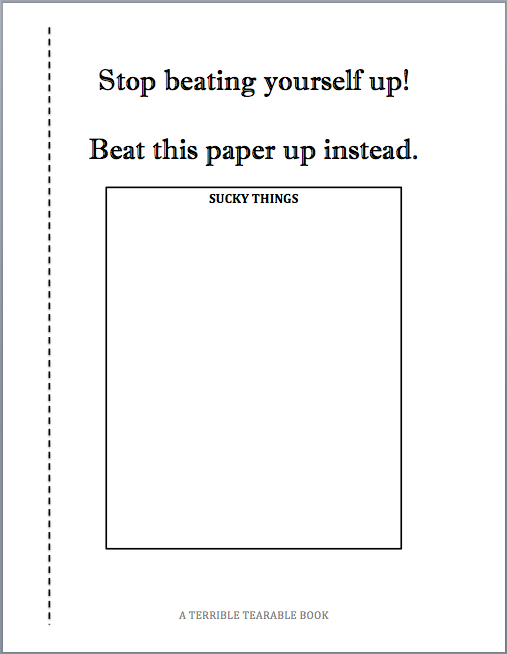
Introducing a Terrible Tearable Book

As someone who reads a lot and has a strong interest in zines and book arts, I love it when I find a book that's not quite like anything I've seen before. Enter A Terrible Tearable Book by Zen Thai.

Have you ever wanted to get your feelings out on paper, but journaling just wasn't enough? Are you a kinesthetic type of person who benefits from adding a physical aspect to a writing or meditative practice? With A Terrible Tearable Book, the author invites you to tear each page out as part of the process of reading/using the book. Some pages are meant to be torn out and torn up, as you work out the residual anger or negativity of a bad day. Other pages are meant to be pinned up on your fridge or wherever you like to keep encouraging notes.

Zen Thai is currently raising money for the publication of A Terrible Tearable Book through this Kickstarter campaign. He has written four other books and has a solid understanding of the publication process.

When you pledge at $24 or more, you're reserving a copy of the book for yourself. There are two versions of the book: one version includes profanity, and the other is a "clean" version. At higher pledge amounts, you can actually be included in the book and even have your own, customized terrible tearable page based on your personal pet peeves. If you pledge any amount to the Kickstarter campaign, Zen Thai will send you a sample page from the book--and he hopes you'll make and share a video of yourself tearing it from the book.

This is a very cool project both in terms of expanding the boundaries of a typical "book" and in terms of being fun and participatory. Really I think this is just the kind of thing that crowdfunding was made for, and I hope that Zen Thai reaches his $3000 goal. As of this writing, he's already one-sixth of the way there. Visit his Kickstarter page to learn more.

Sunday, March 22, 2015

Meet Julian H. Scaff, Author of Sketch Your Soundscape

Julian H. Scaff is an an electronic musician, visual and user experience designer, and university professor. He is the author of Sketch Your Soundscape, available from Designing Press and Amazon. Learn more about Julian's work by visiting his website.

1. Why do you talk about the idea of "sketching" when it comes to the practice of hearing/ listening?


In a broad sense, a "sketch" is a rough, unfinished drawing of ideas. It's a very efficient means of recording ideas and information in ways that are useful, both for developing skills and for being able to recall those ideas or data later on. We tend to think of sketching in relation to visual media, so painters will make sketches to develop an idea before setting paint to canvas, or a designer sketches ideas before making a final rendering in Photoshop. But I've found that sketching is also a great tool for working with sound. I've tried some different ways of sketching soundscapes, both for my own work and with my students, and the template in my book is a result of those experiments. What's different about sketching sound as opposed to something visual is that you can never make a freeze frame of sound. Sound can only exist in the flow of time, and only within a spacial orientation to the listener, so the template I developed for sketching soundscapes allows the listener to sketch sounds in both space and time.

2. What are some common constraints or habits that prevent us from really hearing the world around us?


The biggest thing is focus. Unless we are in a very quiet place, there is always so much sound going on around us that we can't really hear it all and be able to function in a normal way. The same is true with our vision: only people with a photographic memory can actually see and focus on every little thing in their visual field, and that's pretty rare. Most of us can't do that. But by practice, focusing our attention, and recording what we hear, we can become better listeners. My book is really designed for that purpose.

3. Would you tell us a little bit about what inspired you to write your book and what audience you had in mind as you wrote it?


The seeds of this book were really planted about five years ago when I was working on a number of sound art projects, including some radio shows I was doing in London, Paris, and Beirut, and I was trying to make sketches and drawings of soundscapes that I was designing. At the time, I was also teaching at a university in the Netherlands, and for a sound art class I began experimenting with sketching exercises with my students, trying out different ideas and methods. Over time and doing a lot of research, I found methods that seemed to work really well and others that didn't. I also found that a book like this didn't exist, so in a lot of ways I designed the book I wish I'd had for teaching.

The audience is first and foremost students, so I designed the book to be small enough to slip into a backpack and inexpensive so that students could easily afford it. Secondarily, I think it could be really useful for sound artists, music producers, sound producers for film and television, DJs, etc. You can not only use the book to sketch existing soundscapes, but also as a compositional tool for creating original works, or even for mapping out stereo and surround- sound design.

4. In your own life and work, what has best helped you become more mindful of sound and to perceive it more fully within the context of the physical body, time, and other layers of our/ your experience?


There are a lot of things. Going back to my youth growing up in Tucson, it probably started with spending a lot of time in nature and just laying on my back and listening to all the sounds of the desert. My childhood was filled with the cacophony of cicadas, noisy little summer insects. In college I started working in radio, and I loved audio editing on old reel-to- reel tape machines and doing live studio recordings. I developed a good ear and sense of timing by recording and editing hundreds of radio station IDs and PSAs, and I also hosted my own late-night radio show for about a year. A couple of early influencers on me were De La Soul and Negativland. They both made such rich, multi-layered recordings, and I spent hours listening to their albums over and over again on headphones trying to dissect all the sounds. And lastly, practicing meditation has helped me a lot, not specifically for listening but more holistically for being able to focus my senses.

As I state in the book, listening doesn't just happen with the ears; you can listen with your whole body. Some sounds can't be "heard," but we can feel them in our bodies. Sound is just vibration. I had a very visceral learning experience with this fact one time when I was doing an artist-in-residency on the island of Crete. After swimming in the ocean, I lay down on a large boulder about 100 meters from the water. As I lay very still in the hot sun, I began to feel faint vibrations on the rock itself. After awhile I realized that the vibrations were synchronized to the waves crashing on the beach. I could feel the sound of the Mediterranean Sea reverberating through stone. It was a subtle but powerful revelation.

Thanks, Julian!

Saturday, February 14, 2015

Introducing Everything You've Ever Done, a Memoir

Amelia Marie Whalen has spent three years writing a memoir called Everything You've Ever Done. On her website, EverythingYouveEverDone.com, Amelia shares the book's table of contents as well as several excerpts from the book. She's in the process of seeking an agent and publisher, and her website is a great way to get an idea of her writing.

I don't want to oversimplify Amelia's 23-chapter memoir; it's hard for a summary to capture the richness of her experience. In short, the book is the story of her connection to her husband, Dave, and their process of dealing with his diagnosis with a fatal brain disease. As this excerpt of the book explains, Dave was diagnosed with Adrenoleukodystrophy (ALD), an illness which destroys the myelin in the brain. His illness was untreatable, and later chapters of the book talk about Dave's death, such as this section about hospice care and his transition into the very last part of his life.

Amelia's writing has a calm and straightforward tone to it; she conveys sadness, love, and perhaps most of all the presence of Dave. For example, ALD made it impossible for Dave to speak, but Amelia describes how she could still hear his voice: "I still couldn’t see the subtleties of Dave's decline. He was so alive. He was so alive. He was so strong and so himself. By that time, I took hearing his voice for granted. Despite his muteness, I could hear his voice."

There is a lot of literature about hospice and end-of-life care, but much of it is from a more clinical perspective. Here is a book which looks with honesty and love at the process of illness, death, and loss. I think a lot of readers will value Amelia's personal perspective on her experiences.

Tuesday, January 27, 2015

Introducing Mavenrose.com and a Book about Movies as Inspiration

If you're interested in the ways that movies can help us explore meaning in our lives, be sure to visit Mavenrose.com. The author behind the site, Primrose Roberts, regularly posts thoughtful content about the ways that we can enjoy movies as a way of gaining perspective on our own situations in life.

The posts combine a variety of interesting source material, such as Jungian archetypes and Joseph Campbell's writings. There's also a connection to the Law of Attraction as the author analyzes the ways that movie heroes reach their goals. In other words, you can look at movies through different lenses and appreciate movies in new ways--and appreciate how they can even help you actualize what you want to achieve in your own life.

Primrose Roberts is the author of a book called SPUN: 101 Movies to Recreate Your Reality. You can get a good idea of the content of the book by visiting her website--and in fact, you can read Chapter 1 of the book there for free. The book is available on Amazon, in Kindle format.

We've always heard the expression about the "magic of movies," so I like the idea of someone taking this notion and exploring it more fully. We spend a lot of time watching movies, so why not watch them in a way that's more active rather than passive? The author also works with the metaphor of "writing a script," extending it beyond screenwriting to the idea of writing scripts for our own lives.

Saturday, January 17, 2015

Meet Eric Wayne Dickey, Author

Eric Wayne Dickey is a poet and the author of a recently published children's book, Alex the Ant Goes to the Beach, published by Craigmore Creations. Find the book on Amazon by clicking here.

1. How did you come to write a children's book?

I wrote it on the occasion of a birth. Close friends were having their first child. I had intended to give it to them as a gift, but I never did. Around that time, I had a friend who was studying entomology and had also gone to art school. I asked her to draw up some ideas of what the main character would look like. But then, as things go, the story languished untouched for over a decade.

I kept writing poetry and other things. As the years passed, I had my own family, and had read hundreds of children's books to my two kids. A few years ago as I was reading a bedtime story to my youngest, I had an epiphany: I could do this. I can write a children's book. I have a creative writing degree and I am a writer. Then I remembered the ant story. So, I dug it up and brushed it off. I read it to my kids and got their feedback, and I read it to some friends and got their feedback. I also connected with some local children's authors, Margaret J. Anderson and Tom Birdseye, who both gave me a wealth of knowledge for which I am still grateful. It's kind of funny, too, because the things that I learned from them, and the feedback that got from my friends, is very similar to the kinds of practical information that I've learned as a poet, but I had to shift my understanding of audience. I had to take the things I learned as a poet and writer, and realign them to address the issues of writing for children. Things like image, structure, and function are approached similarly but with different intentions. After assimilating all the feedback and soul searching, I started researching publishers.

I had found a few publishers that I thought would be interested, Sterling, and Scholastic, or course. As I kept researching, I learned that I should pursue publishers who specialize in science literacy. The book explores entomology and coastal and ocean topics for young people. I found Dog-Eared Publications, and had started drafting a query letter. Around that same time, I had caught up with an old friend who had just finished working for a new, independent children's book publisher in Portland, Oregon: Craigmore Creations, which specializes in science literacy and children's books. I reviewed their catalog and checked out a few of their books from the library. I noticed that they didn't have any books for three-to-eight year old readers. So, I decided to query them first. I used my hook for expanding their offerings, my connection to my friend who had worked there, I focused on my story and its potential, and I sent the query letter. And wouldn't you know it, they said, "Yes!" It's unusual to get an acceptance right off the bat. Usually, book inquiries for new writers get rejected a dozen times or more. I was elated, to say the least.

2. Being a father surely helped. Did being a poet help?

Absolutely. The language and word choices in children's books, as in poetry, need precision. There can be no room for misinterpretation. I labored over each sentence, the phrasing, each word, if not each letter in the story. What's more interesting is that I had to leave room in the text for the imagination. In the case of poetry, we leave room in the text for the imagination of the reader. While this is true for children's books, we also have to leave room in the text for the illustrator. The text and the illustrations work together.

3. What did you learn about children's publishing?

I learned that writers should only submit texts to publishers. This is not always true, of course, but for new writers it is true for several reasons. Children's book publishers have their own cadre of illustrators that they keep on staff or on contract. This helps them develop a consistent brand identity. For example, Scholastic books generally look like Scholastic Books. Each publisher has a their own aesthetic, their own certain appeal, and a specific look that helps them establish their markets. So, submitting a text to a publisher will allow their illustrators to imagine what the story will look like. If you submit a text with illustrations, the illustrations will influence the way the publisher sees the book. Or, as Tom Birdseye put it, "You don’t want to give a publisher two reasons to reject your work." Just submit the text, and only give them one reason.

Oddly enough, this advice is useful to poets, too. When writing and formatting a poem, don't give your readers too many reasons to reject your poems. Authenticity in poetry easily couples with accessibility. Poets can be nurturing and kind, as well as difficult and thought provoking as long as their voice is authentic.

Another thing I learned about children's publishing that readers find surprising is that I have never met the illustrator. While I did have input on early drafts of drawings, the illustrator was fairly autonomous. And I now see why that is absolutely necessary. Illustrators need their own license to express their art; working too closely with an author would alter and slow the outcome.

4. What are you reading?

Whenever there is a poetry competition list of finalists announced, I always get the listed books for poetry. Whether it's the Pulitzer, the National Book Critics Circle Award, or the National Book Award, I binge read all the finalists. I am currently reading the finalists in poetry for the National Book Award for poetry. The one I am on now is Spencer Reece's The Clerk's Tale. I have to say, it is the real deal. I also have Brian Blanchfield's A Several World in the queue.

The fiction I am currently reading is Peter Matthiessen's Shadow Country. That one is a long haul and will take me a while to finish. I am also reading Censoring Translation by Michelle Woods. I have an unpublished translation that nobody wants to publish, and am trying to figure out how I should proceed.

5. What's next? What are you working on now?

I submitted a sequel to the publisher for Alex the Ant. In this second installment, Alex the Ant Builds a Bridge, Alex pursues engineering and the book explores issues of climate change. I have a third installment in mind where Alex will explore social identity and atmospheric science and astronomy. It is very exciting being a new children's author. It's a completely new identity for me, and it’s been a lot of fun. I just hope that this first book, Alex the Ant Goes to the Beach, sells well enough to justify a second book. With good sales, the publisher may also consider a Spanish translation, too. So, I hope your readers will consider supporting the effort and buy the book. It's a really fun story with lots of fun words to say.

As for children's stories, I am researching other books as I am developing a couple new storylines. One on diaspora for tween girls, and another on homelessness for young children. P.D. Eastman's The Best Nest is a fascinating account of homelessness that captures the sense of hopelessness and urgency displaced family feels.

As for poetry, I am also working on a series of poems called The Book of James about the sudden passing of my only sibling. It's a book-length elegy that takes famous people and places named James and addresses them as if they were my brother, James River for example, or Jesse James. I really want to finish this collection. It is coalescing for me, and I am beginning to see the light at the end of the tunnel. Of course, if the light goes off, then I'm just in a hole in the ground. I have this idea that the collection should be forty-two poems, and I think I am getting close to thirty.

I am also starting to work on my next poetry project and have already written a few poems, which, in my mind, I call, The Crazy Poems. One of them, "Train 19," is forthcoming from a new zine being produced by Lars Palm called Swirl.

I have outlines to some fiction pieces I would really like to dive into. I imagine them as a series of stories about surviving in a post-apocalyptic world. I can guarantee they will not have any zombies.

It's difficult for writers to keep writing, with all the other obligations we have: work, family, house, health, etc. I find that having a variety of reading and writing projects helps keep the momentum moving forward. I write for my day job, too; I'm a grant writer. I help develop and write grants for researchers, and I am working on a couple of really exciting projects that also use a little of my creativity. For me, it's the journey and not the destination. I have to keep reminding myself of that because otherwise, I get too caught up on acceptance and products and success. Editing and seeking publication are fun, but I'd rather be writing.

Thanks, Eric!

Thursday, November 20, 2014

Meet Ritoban Chakrabarti, Author and Internet Marketer

Ritoban Chakrabarti has loved the internet since he first got an internet connection in 2005. He studied computer science in Chandigarh, and he became a full-time internet marketer in 2008. More recently, he published his first novel, When She Smiled. Learn more about Ritoban's fiction writing at www.WhenSheSmiled.com, and on Goodreads. And learn more about Ritoban on his website.

1. How did you first become interested in internet marketing?

It all started when I was in college pursuing my engineering degree. We had a lot of free time, and while most of my friends would go out to parties, I was never too fond of partying. I decided to sit at home and work on my passion, which at that time was making websites.

There's something about making websites that brought out my creative side, and I loved it. Soon, I started freelancing and started making websites and doing graphic designing for clients. I started making a proper livelihood out of it, and as soon as college was over, I got more and more into it.

Soon, I realized I was taking on more projects that I could handle, and that's when I started my first company. It's been an amazing five-year journey since then, and we have done some remarkable things in the field of internet marketing.

2. Have you always had an interest in writing and publishing fiction?

I used to be an avid reader as a child, but since college my reading habits had been suppressed because I got busy with engineering studies and my internet marketing work. But recently, I started reading again, and I had an epiphany a few months ago about writing a novel, and I followed that dream.

To be completely honest, it has been on my dream board for a long time, but I seriously considered it only a few months ago.

3. What's your novel about?

The novel is about a teenager who grows up in the mountains of Shimla, in India. It describes how he meets a girl in a school and falls in love, and how she changes his perception of feelings, hope, and life altogether. It's a very simple story, but I believe everyone can relate to it because we have all gone through first love, and we know it changes our life.

4. How are you utilizing your background in marketing and entrepreneurship to promote your novel?

I noticed a big trend in the publishing industry, especially in India. Most of the authors here don't do much marketing of their books. Essentially they are authors, not marketers. My marketing background helps me to claim that uncharted territory because I know how to promote any product using websites, online ads, and email marketing.

I'm using all my knowledge and more for marketing this novel. Since I have about three months more before the launch of the book, I'm pretty sure I can create enough buzz around the book to get it on some bestseller lists.

5. What's your advice to independent entrepreneurs--and/or indie authors/artists!--who are facing a lack of encouragement from family, friends, etc in their pursuit of their goals?

To be honest, I didn't have much support from my family when I told them I wouldn't pursue an MBA degree, and that I wanted to open my own company. They were very reluctant, but I was more stubborn than they could handle. I kept following my passion, and slowly they got to be a part of my success. Now, they proudly tell everyone they meet about what I do and how I got there.

I have always believed in "hustling." No matter how adverse your situation may be, if you're somebody who can hustle long and hard at what they believe in, no one will be able to stop you. Your success is in your hands. Your failure is also in your hands. So keep hustling, and you'll see how each of your goals will keep becoming a reality.

Thanks, Ritoban!

Saturday, November 8, 2014

Meet Tammy Thompson, Author

Tammy Thompson is 26 and lives in Pittsburgh, PA. She's a college graduate with a bachelor's in Psychology, and she will be soon be going back to earn her master's degree. Tammy has written her autobiography and made the book available to read for free online on her website, God's Great Glory.

1. How long did it take you to write your autobiography?

I started writing my autobiography when I was 15. As the years went on, I continued to write about my experiences while I was going through them. At completion, it took ten years to finish the book.

2. What inspired you to write down your personal story to share with others?

I originally never knew I was going to end up writing my autobiography. As mentioned earlier, I started writing my story at the age of 15. At that time, I was residing in a shelter for teenage girls. We were all given journals and were told to write in them every day. Lucky for me I enjoyed writing. It dawned on me one day that I could turn my journal entries into something people could learn from--something inspiring.

3. Why did you decide to share your autobiography online on your website?

I wanted anyone to be able to access my story for free online. By creating a website, I knew I could also provide other resources for those who may be in need of help.

4. Are you planning to pursue a career in the ministry--or possibly in the helping professions such as social work?

I am planning to pursue a career in counseling. I am in the process of obtaining my master's degree, and then I want to become certified in grief counseling. I want to help people in any way I can.

5. Based on your personal experiences, what do you see as some specific ways that all of us could work on advocating for children in foster care?

Based on my personal experiences, I believe the foster care system is flawed. I was taken from one bad situation and put into an even worse situation by going into foster care. I believe there needs to be better resources for first-time foster parents so they can get a grasp on what their foster children will be going through and feeling. Essentially, there needs to be more support for these families.

Thanks, Tammy!

Tuesday, September 23, 2014

Meet Katherine Elberfeld, Author and Episcopal Priest

Founder of Gabriel Center for Servant-Leadership, Katherine Elberfeld has devoted her life's work to spreading the power and healing touch of servant-leadership throughout the world. Prior to establishing the Gabriel Center, Ms. Elberfeld, an Episcopal priest, served parishes in Northern Virginia for five years. Before entering seminary, Ms. Elberfeld worked as a newspaper reporter, freelance writer, and editor. Her articles on servant-leadership have appeared in regional and international publications including, Leadership, New Therapist, , Leadership in Action, The (Lexington, Ky.) Advocate, Virginia Episcopalian, Washington Diocese, and Pathways, the official magazine of the Episcopal Diocese of Atlanta. Ms. Elberfeld's published work also includes, To Speak of Love: Reflections on Servant-Leadership in Life and Work, and a novel called The Lady of the House.

1. What inspired you to write The Lady of the House?

Simply put, the book would not leave me alone until I had written it. Even now, when I cross those concrete bridges with slatted railings along the side, like the bridge described in the book where Annie and Danny explore one day, I feel a sense of relief and contentment that that bridge, its description and the nostalgic longings it gives me, the pull it has on me, are out of me and onto the page and into the book.

2. Why is revisiting the past so important to the narrator of your book?

Annie wants to know how she came to be the woman she is, why she made the decisions she did that shaped her life so profoundly. It is her belief that she will discover the answers to those questions by exploring the past. The underlying hope is that the past will tell her what she needs to know so that she can make different kinds of decisions going forward, helping her to carve out a life more in tune with her longings, values, her true self. That she can lay to rest the regret from which she suffers so profoundly, gain some peace and make choices going forward that will lead to deeper contentment, help her life to be in alignment with her deepest self.

3. How has your work as an Episcopal priest informed your work as a writer?

It's really been the other way around in some ways--I have been writing since I was five, and for publication since 1975. When I entered seminary in 1990, I already had a lot of experience writing professionally behind me. In homiletics (preaching) class, I was very fortunate to have a professor who stressed the same approach to writing sermons as my college creative writing professor had: show it, don't tell it. That really lit me on fire, and I had a wonderful time incorporating that into my preaching and still feel that it's one of the strongest components of my ministry.

4. What projects do you see yourself taking on the next year or two?

My publisher and I are in the process of proofing a collection of my short stories, and then I will continue to work with them on the production of the book. With help from my publicist and others, I am establishing a website, KAEwrites.com, to communicate with others about the process of discovery that in my case leads to writing which leads to more discovery. Through my writings, I share my journey with others, and I look forward to hearing about other people's journeys as well, and together we will go forward.

I will also return to a novel on which I've been working which is a fictional account of a woman in the Episcopal priesthood. Should be interesting!

Thanks, Katherine!